
On this page
Which gutter problems can be repaired?
Most of them. The usual Asheville repair list is short: joints that drip, runs that sag, sections bent by falling limbs, downspouts that are blocked or have come loose, fascia that has rotted behind the gutter, and drainage that sends water the wrong way on a sloped lot. Each has a standard fix, and most take a few hours.
What causes each problem, and what fixes it?
| Problem | Usual cause | Usual repair | Page |
|---|---|---|---|
| Drip at a corner or end cap | Failed sealant | Clean, rivet, reseal | Leaking gutters |
| Run sags or leans | Loose spikes, wide spacing, soft wood | New hidden hangers, fascia repair | Sagging gutters |
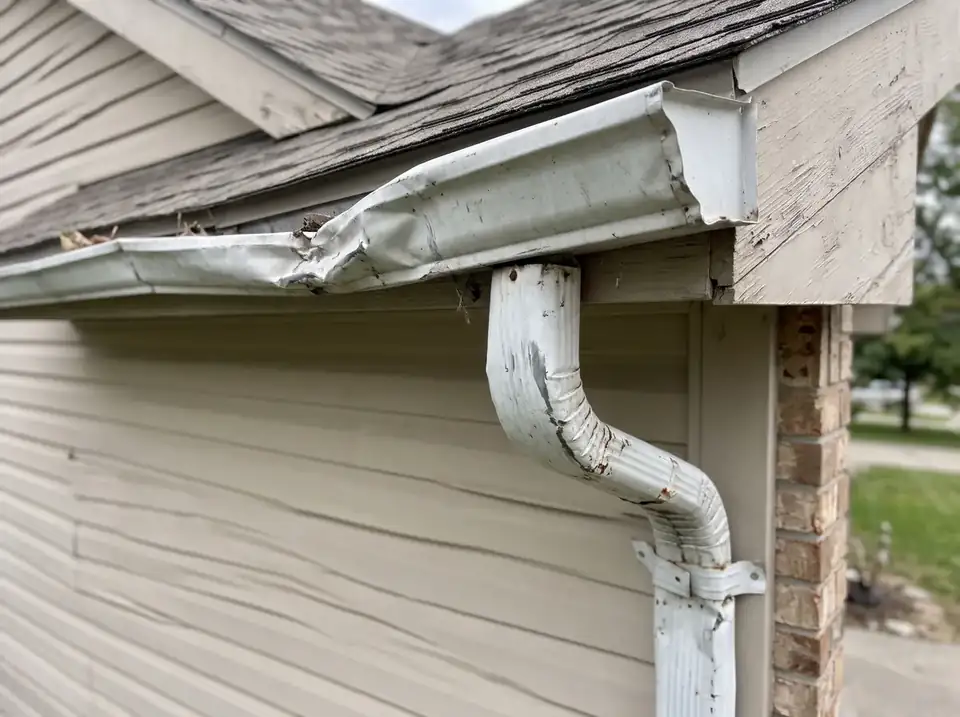
| Bent or torn section | Falling limb, wind, ladder | Replace the section or the run | Storm damage |
| Water behind the gutter | No drip edge, rotted fascia | Drip edge or apron, new boards | Fascia and soffit |
| Overflow at one corner | Clogged outlet or downspout | Clear, flush, add cleanout | Downspout repair |
| Water running at the house | Discharge on the uphill side | Reroute, buried line, swale | Hillside drainage |
| Overflow across a valley | Gutter too small for the flow | Diverter, larger outlet, 6-inch | 6-inch gutters |
How does a repair visit run?
Find the source
The contractor traces where water is getting out: a joint, a low spot, a blocked outlet, or water getting behind the gutter.
Check the wood
Fascia around the problem is probed for soft spots, because a repair on rotten wood does not last.
Make the fix
Reseal, rehang, replace a section, clear a downspout or reroute drainage, depending on the cause.
Test with water
A hose run in the gutter confirms that the leak has stopped and that water reaches the outlet.
Flag anything else
A good contractor points out other weak spots, such as old spikes or a corner close to failing, without pushing a full replacement.
Why do Asheville gutters need repairs?
Three local conditions do most of the damage.
Trees. Asheville's tree canopy covered 44.5% of the city in the 2019 study, and the city notes that Helene significantly damaged that canopy. Mature oaks, maples, poplars and pines drop leaves, seeds and needles that pack into troughs, and limbs that fall in wind and ice bend gutters and pull downspouts off walls. Trees weakened by storms can keep dropping limbs for years.
Rain in bursts. Average rainfall is steady, around 45 inches a year, but storms are not. Summer thunderstorms and the remnants of tropical systems can deliver inches in hours. Helene brought 13.98 inches to Asheville over three days in 2024. Small or clogged gutters overflow, and the water goes where it does damage.
Slopes. Water that leaves a downspout on a hillside keeps moving. If the ground falls toward the house, it ends up against the foundation or under the crawl space.
When is replacement the better call?
Repair makes sense when the gutters are basically sound. Consider replacement when you see several of these:
- Leaks at most joints, not just one or two.
- Old sectional gutters with seams every 10 feet.
- Rust through steel gutters, or splits along the run.
- Gutters too small for the roof, overflowing even when clean.
- Spike-hung runs that keep dropping no matter how often they are refixed.
- Fascia rot along most of the house, which means the gutters will come down for carpentry anyway.
The repair or replace guide sets out the trade-offs with rough costs.
What does gutter repair cost?
Repairs are usually priced as a visit plus parts and time, not by the foot. A few resealed corners and a handful of new hangers on a one-story house cost far less than replacing a section damaged by a limb on a tall rear wall. Fascia carpentry, steep access and buried drainage add most to a repair bill. Ask for the quote to list each item separately.
Is it safe to repair gutters yourself?
Simple jobs on a one-story house, such as clearing an outlet or adding a downspout extension, are within reach for many homeowners. Ladders on soft or sloping ground are the risk; many Asheville yards offer no level footing. Leave work on second stories, steep banks, roofs near power lines, and anything involving storm damage to a contractor.
Repair terms explained
| Term | What it means on an Asheville house |
|---|---|
| Miter | A corner where two runs meet. Formed corners or cut, riveted joints are sealed inside, and this is where most leaks start. |
| End cap | The piece closing the end of a run, crimped or riveted and sealed. Old sealant here is the second most common drip. |
| Spike and ferrule | The older fixing: a long nail through a sleeve and the gutter face into the board. Freeze, thaw and wind work them loose over time. |
| Hidden hanger | A bracket clipped inside the front lip of the gutter and screwed through the back into the fascia. It cannot be seen from the yard. |
| Fascia | The flat trim board fixed to the ends of the rafters along each eave; hangers screw into it, so its condition decides how well a gutter holds. |
| Soffit | The underside of the roof overhang, often vented to let air into the attic. Stains here usually mean water is getting behind the gutter. |
| Drip edge | L-shaped metal strip at the roof edge that kicks runoff forward so it lands in the trough instead of running down the board. |
| Gutter apron | Longer flashing tucked under the shingles and lapped into the gutter, used where water keeps finding its way behind the trough. |
| Outlet | The hole in the floor of the gutter and the short sleeve, or drop, that leads water into the downspout. |
| Cleanout | An access fitting where a downspout joins a buried line, so leaves and grit can be flushed out before they block the pipe. |
| Downspout strap | The band fixing a downspout to the wall, usually every 6 to 8 feet, so wind and ice do not pull it off. |
| Swale | A shallow grassed channel in the yard that leads surface water around the house and away on a sloping lot. |